Search This Blog and Its Links

Sunday, March 10, 2013

A Billboard That Creates Drinkable Water Out Of Thin Air

Facts: The billboard pictured to the right is real. It’s in Lima, Peru. It produces around 26 gallons of water a day from nothing more than humidity, a little electricity, a basic filtration system and gravity.

Although the atmospheric humidity averages around 83%, Lima gets about half an inch of precipitation a year, making it one of the driest cities on earth. With this technology, potable water can be made available to all.


Saturday, March 9, 2013

Friday, March 8, 2013

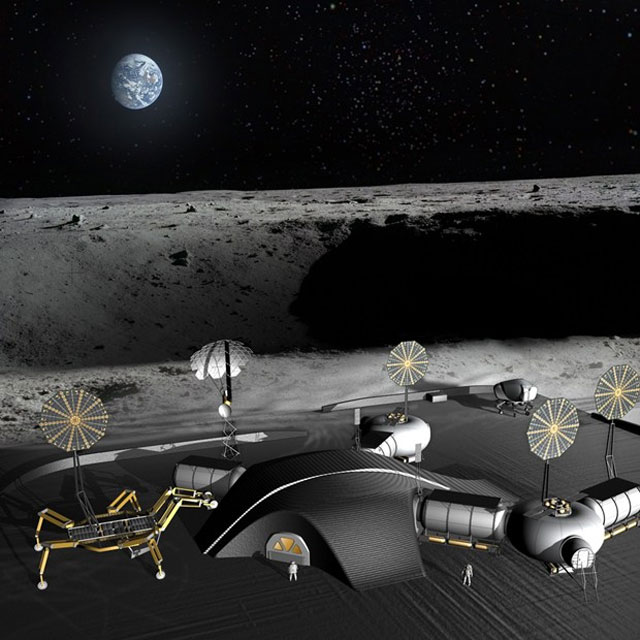
Giant NASA Spider Robots Could 3D Print Moon Base

From Ars Techica comes the news that the first Moon base might not be man made. Space architects Tomas Rousek, Katarina Eriksson and Ondrej Doule and scientists from NASA's Jet Propulsion Laboratory (JPL) are cooking up a plan to build giant spider robots to do the construction.

They propose using microwaves, no more powerful than your kitchen's, to melt lunar dust and fuse it into solid blocks and then the giant spider robots (I never get tired of writing those words) would assemble the habitat.

Sound like science fiction? Here's a video of a half-size prototype of the giant spider robot.

Thursday, March 7, 2013

How Long Is Humanity’s Future?

Oxford philosopher Nick Bostrom spends an inordinate amount of time writing about human extinction. He believes that there are good reasons for mankind to contemplate its end. After all, 95% of all the species that have ever lived on this planet are extinct.

But what really keeps Bostrom up at night is not the thought of annihilation by asteroid or global warming. It's the thought that our undoing will be the very technologies that we've created.

The things that worry him most? Biological tech and artificial intelligence (AI). Each could herald the demise of humanity. Nuclear war is down the list somewhat.

On the other hand there's Daniel Dewey. He spends his time imagining a future where AIs cure diseases and help us get to the stars. All this is happening at Oxford's Future of Humanity Institute.

How long is humanity's future? Here's link to the article by Ross Andersen, who went to Oxford to interview Bostrom and his colleagues to ask that question.

Wednesday, March 6, 2013

Travel Photo of the Week

Pearl Waterfall, China


Tuesday, March 5, 2013

The New "X" Particle

Exciting word from CERN that there is a new X particle out there. Discovered by physicists in Japan in 2003, it took a backseat while everyone else was all caught up in finding the Higgs Boson.

This week, at a conference in Italy, CERN presented the first full measurement of the quantum numbers of the X. The result? The X is not a meson and is something much more exotic.

LHCb physicist Dr Matt Needham has said, "this measurement is a great step forward in understanding this mysterious X. The real nature is still unclear."

But they are expecting that it's nature will soon become clear. Whatever that result, CERN is confident that this particle is an "altogether new state of matter."

Monday, March 4, 2013

We Didn’t Domesticate Dogs. They Domesticated Us.

In this wonderful piece published on National Geographic's website, Brian Hare and Vanessa Woods opine that mankind was probably approached by friendly wolves and  that instead of thinking of evolution as being the survival of the fittest, perhaps we might better think of it as survival of the friendliest.

"Most likely, it was wolves that approached us, not the other way around, probably while they were scavenging around garbage dumps on the edge of human settlements. The wolves that were bold but aggressive would have been killed by humans, and so only the ones that were bold and friendly would have been tolerated."

The two researchers believe that it was this relationship that caused the animals to not only change their appearance (splotchy coats, floppy ears, wagging tails), but also their psychology. They evolved the ability to read human gestures.

 "As dog owners, we take for granted that we can point to a ball or toy and our dog will bound off to get it. But the ability of dogs to read human gestures is remarkable. Even our closest relatives-chimpanzees and bonobos-can't read our gestures as readily as dogs can. Dogs are remarkably similar to human infants in the way they pay attention to us. This ability accounts for the extraordinary communication we have with our dogs."

And they believe that with these new abilities, people who used dogs to hunt would have a distinct advantage over those who did not and argue that the dogs realized that allying with humans improved their odds at the hunt, also. They also suggest that dogs may have been the catalyst for our civilization.

Maybe in another thousand years, they'll be able to talk. I hope so.

Here are two more links on this. One from the Wall Street Journal and another from Smithsonian.

Sunday, March 3, 2013

Seeing Through Fire

One of the difficulties firefighters face is being able to see if someone is trapped behind flames. By shining infrared laser light into a scene, information carried by rays reflected by objects or people can be  reconstructed to see if this is the case. This technique was used  to produce the video below.

Developed by Pietro Ferraro and colleagues from the National Institute of Optics in Pozzuoli, Italy, they plan to make a device that houses both the laser and the holographic camera, so the system can be placed inside buildings or tunnels. There appear to be biomedical uses, also.

Here's a link to the original New Scientist article.

Saturday, March 2, 2013

Fun Time! LEGO Ghostbusters Headquarters!

From LEGO toy artist Alex Jones, comes this wonderful creation: the Ghostbusters headquarters done in LEGOS!


It is fully furnished on the inside. Mr. Jones used both films and the cartoon series as guides to what all the rooms contained. Here's link to his site which has many more photos and a short video on this special piece of fan goodness.

Friday, March 1, 2013

Is Cocoa The Brain Drug Of The Future?

That's the title of an article in Scientific American highlighting research done at the University of L'Aquila in Italy that shows that raw cocoa may be packed with brain-boosting compounds. The research suggests that cognitive function in the elderly is improved by ingesting high levels of natural compounds found in cocoa called flavanols.

But don't gorge on chocolate yet; most of the cognition enhancing compounds are removed during the process of making the the candy. Even dark chocolate has most of the flavanols removed.

One curious correlation of greater national chocolate consumption is highlighted in the article:

"The more chocolate a population consumes, the more Nobel Laureates it has: Columbia University's Franz Messerli discovered a positive correlation between annual chocolate consumption per capita and a country's number of Nobel Prize winners per 10 million people. The study is not meant to seriously imply that brilliance is the result of chocolate consumption—although Messerli believes chocolate probably has some benefits, his analysis was inspired purely by whimsical curiosity and exemplifies the hazards of reading too much into a correlation."

There's some food for thought.